


Decarbonisation Newsletter - COE Chakra


Decarbonisation Newsletter
Sustainable Aviation Fuel
The Clean Sky Imperative
India is now the world’s third-largest aviation market, and it is still growing at close to 11% a year. New airports are opening, airlines are adding hundreds of aircrafts, and more people fly with every passing year. That growth burns fuel. Jet fuel demand is set to almost double from about 8.8 million tonnes in FY25 to 15 to 16 million tonnes by FY30, and the sector’s carbon footprint will climb with it.
For most of the economy, the path to decarbonisation is becoming clearer. Flying is different because there is no easy electric replacement for a large aircraft. Even as road transport cleans up, aviation’s share of India’s transport emissions is set to roughly double, from about 5% today to 8-10% by 2030. That works against India’s pledge to reach net zero by 2070. Of the handful of ways to cut aviation’s carbon, global aviation bodies expect Sustainable Aviation Fuel to do most of the work, contributing 50-65% of the emission reductions the sector needs to reach net zero by 2050.
The pressure is not only environmental; it is now regulatory too. From 2027, International Civil Aviation Organisation’s (ICAO) Carbon Offsetting and Reduction Scheme for International Aviation (CORSIA) becomes mandatory for all member states, including India. Every Indian carrier on international routes must then neutralise emissions growth above 2019 levels, either by purchasing carbon offsets or by using certified SAF. Indian airlines are already facing a challenge on account of depreciating rupee. Dollar denominated expenses like purchase of Aviation Turbine Fuel, aircraft lease rentals and maintenance are adversely affecting the financial health of airlines operating in India. Without a domestic supply, Indian airlines face a compounding offset bill that could run into hundreds of crore rupees a year as their networks expand, a cost that ultimately lands on either airline profitability or passenger fares.

The sheer scale of that demand sharpens the urgency. India is on course to serve around 500 million air passengers a year by 2030, and because a new SAF plant takes 3-4 years to build, that capacity has to be commissioned well before these obligations take hold. The country has begun to set the pace itself, with blending targets rising from 1% in 2027 to 2% in 2028 and 5% by 2030. All of this raises a simple question: what exactly is the fuel India is racing to produce?
What SAF actually is
Sustainable Aviation Fuel, or SAF, is jet fuel made not from crude oil but from materials such as used cooking oil, farm waste, household garbage and even captured carbon dioxide. Across its full life cycle it releases 40-80% less carbon than ordinary jet fuel. Its most useful quality is that it is a drop-in fuel: it meets the same quality standard as normal aviation turbine fuel and works in today’s aircraft and airport systems with no changes at all.
A fair question is why aviation cannot simply switch to electricity, as road transport is doing. The answer is weight. A single wide-body aircraft can burn up to a lakh litres of fuel on a long flight, and no battery in sight can hold that much energy without being far too heavy to fly. For journeys of three to fifteen hours, which cause most aviation emissions, liquid fuel will stay irreplaceable for the next 15 to 20 years. SAF is therefore not a stopgap but the only practical bridge to cleaner flying available now.
SAF still gives off carbon dioxide when it burns, just like ordinary fuel. The difference lies in the fact that its raw materials recently took that same carbon out of the air, so very little new carbon is added overall. India’s own DILSAAF technology, developed by the Council of Scientific and Industrial Research with the Indian Institute of Petroleum, cuts carbon by up to 75% and allows blends of up to 75%, far above the 50% limit that applies to most approved fuels elsewhere. That explains what SAF is; how it is made is a different story, and there is more than one way to do it.
Four routes to the same fuel
It all begins with the feedstock, the raw material the fuel is made from, and here India is unusually well placed. The country produces about 230 million tonnes of surplus agricultural residue every year, most of it rice, wheat and maize stubble that is currently burnt or left to waste. On top of this it generates roughly 2 million tonnes of used cooking oil and around 61 million tonnes of municipal solid waste. If used properly, this base could support an estimated 8 to 10 million tonnes of SAF a year. What differs across the options is how each of these raw materials is turned into fuel.
SAF is a single fuel, but it is not made in a single way. There are four main routes, each starting from a different raw material and ending in the same product.
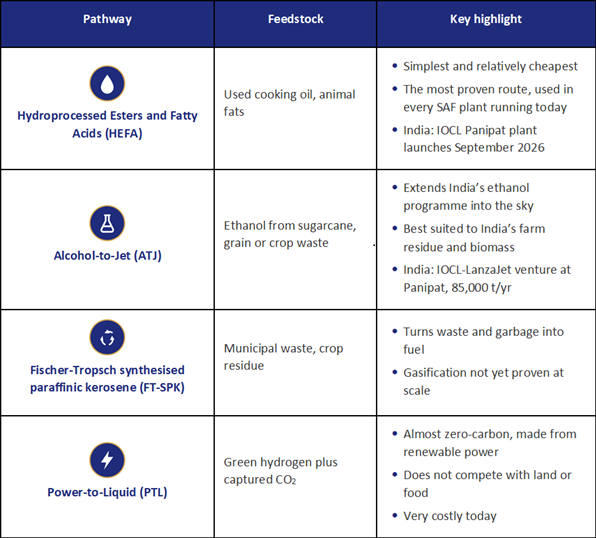
India's SAF strategy follows a phased technology pathway, scaling proven routes such as HEFA and ATJ today, building capabilities in Fischer-Tropsch over the medium term, and positioning for Power-to-Liquid fuels in the longer term. Its sharpest advantage, though, is ownership. Most countries license SAF technology from foreign firms and pay royalties indefinitely. India’s CSIR-IIP has instead developed its own single-reactor HEFA process, DILSAAF, which is simpler and cheaper to build and reaches a blending capability that imported technologies cannot match. The 2027 demonstration plant at MRPL Mangalore marks the point at which India moves from buying this technology to owning it.
Proven, but not yet affordable
Owning the technology is one thing; proving it works at full scale, and at a cost-effective price, is another. On the first count, SAF has already passed the test. Airlines have flown complete commercial services across the Atlantic on 100% SAF, showing regulators that large twin-engine aircraft can cross oceans safely without a drop of fossil fuel, and major airports now blend it into everyday operations.
On the second count, the answer is not so simple. If SAF is so good, why is it not used on every flight? The clue lies in cost and scale.

SAF still costs about twice as much as ordinary jet fuel, and fuel already makes up roughly a third, of an airline’s running costs, so switching over completely would wipe out thin margins and push fares up sharply. Supply is also scant, still under 1% of global jet fuel demand. This creates a familiar deadlock: producers will not build costly refineries without buyers, and airlines will not commit while prices stay high. Seen from a passenger’s seat, though, the cost is small in the initial stage. At a 1% blend, SAF adds only about Rs 100 to 200 to a ticket, less than a meal at most airport food courts, and the benefit grows as the blend rises towards 5%.
An India story, not just an aviation one
If read only as a problem airlines face, SAF can look like an expensive obligation. Read as an India story, it looks very different, because its benefits reach far beyond airports and touch many people who will never board a plane. For farmers in Punjab and Haryana, the crop stubble that is burnt every October, because collecting it costs more than anyone will pay, becomes something a refinery will buy at the gate. For cities in the north, removing that reason to burn is the single biggest controllable way to cut winter smog. For travellers, SAF is a real and measurable way to fly greener, unlike offsets whose value is often doubted. And for the wider economy, every tonne made from local waste is a tonne of crude oil that India does not have to import.

It is rare for one policy to do so many things at once: raise farmer incomes, clean city air, offer greener travel, shield airlines from a rising offset bill, support local industry and trim the oil import bill. That is why SAF deserves everyone’s attention. India has every ingredient it needs, including plentiful farm waste, deep refining experience, home-grown technology and a fast-growing market that creates both the duty and the demand to bring costs down. The technology is proven, regulatory frameworks are set, and the next frontier is execution
Authored by
Shyam Namboothiry M M (Credit Analyst)
SBI CHAKRA Centre of Excellence
Decarbonisation Sectoral Insights
Decarbonisation represents the systematic reduction of greenhouse gas emissions across energy, industry, transport, and land use. Net zero is achieved when remaining emissions are counterbalanced by removals through natural or engineered sinks, preventing further accumulation in the atmosphere. The path to net zero demands steep emissions cuts as a first priority, with offsets restricted to residual volumes. Despite a decade of policy milestones from the Kyoto Protocol to COP29, current pledges still imply a 2.0–2.7°C rise in global temperatures by 2100, far above the 1.5°C threshold that scientists consider critical to avoid irreversible climate tipping points. Unchecked emissions would expose half the world’s population to lethal heatwaves, put one billion people under acute water stress, and erode trillions in financial value through stranded assets and regulatory penalties.
Corporate and national strategies now reflect the shift from ambition to operational targets. More than 10,000 companies have committed to Science Based Targets by January 2026, more than fourfold increase since 2021. India has pledged net zero by 2070, supported by interim goals to expand non-fossil generation, nuclear capacity, and rail decarbonisation. Industry leaders such as SBI, Adani, and Tata Steel have already disclosed emission reduction pathways, signalling momentum in both developed and emerging markets. Meeting global commitments requires USD 100–140 trillion in cumulative investment by 2050, focusing on electrification, renewable energy, carbon capture, and efficiency improvements.
A structured framework for decarbonisation separates internal levers from external ones. Internal levers drive direct reductions within operational boundaries through efficiency upgrades, renewable energy procurement, fuel switching, and carbon capture. These primarily address Scope 1 and 2 emissions while shaping Scope 3 through supply chain requirements. Energy efficiency remains the fastest-return option, renewables eliminate Scope 2 dependency, and fuel substitution addresses hard-to-electrify sectors. Carbon capture and storage, although capital intensive, remains essential for heavy industry. Only when these options are exhausted should offsets be used, with projects spanning avoidance mechanisms such as forest conservation and removals like afforestation and DAC.
Biofuels offer an immediate transition pathway for aviation, shipping, and freight where electrification is constrained. First generation fuels provide scale but face sustainability challenges, while second and third generation pathways balance emissions reductions with food security and biodiversity. India’s ethanol plants already deliver competitive margins, though capital costs and feedstock fragmentation constrain growth. The sector provides opportunities for rural employment, energy security, and global investment inflows, yet must navigate volatility in feedstock pricing, competition from electrification, and policy execution gaps.
Carbon markets complement these efforts by monetising avoided or removed emissions into tradable credits. From the Kyoto Protocol’s Clean Development Mechanism to Article 6 of the Paris Agreement, frameworks have evolved into emissions trading schemes, carbon taxes, and voluntary crediting systems that now cover a quarter of global emissions. COP29 operationalised Article 6, creating linkages between compliance and voluntary markets and reinforcing transparency through biennial reporting. Integrity of credits is critical, with quality defined by additionality, permanence, verification, and co-benefits. Indian Carbon Market, launched in March 2026, will initially target companies in Energy, Industries, Agriculture, Waste handling and disposal, Forestry and Transport and later broaden into Fugitive emissions, Construction, Solvent Use, Carbon capture, utilisation, storage of CO2 and other removals, offering both domestic compliance and export potential.
Financing underpins every element of the transition. Institutions such as GFANZ have committed USD 130 trillion in assets to align portfolios with net zero. Financing needs range from megawatt-scale solar retrofits to billion-dollar CCUS hubs, requiring diverse structures such as green bonds, sustainability-linked loans, blended finance, and insurance-backed guarantees. Banks play a pivotal role by directly funding projects, advising corporates on transition pathways, and embedding emissions-linked terms into products. Green market makers and exchange platforms are emerging to provide liquidity, absorb green premiums, and professionalise trading of carbon-linked assets. Ultimately, the bottleneck lies not in technological availability but in capital mobilisation. The credibility of the decarbonisation agenda will be judged by whether financing flows quickly enough to scale biofuels, CCUS, offsets, and renewable infrastructure into mainstream global systems.
Access Detailed Sectoral Insight Reports
 (2343 KB)
Last Updated On : Thursday, 16-07-2026


